
Some words are always close to us. We hear them in conversations, encounter them in books, and use them without giving much thought to their history. Other words gradually move into the background. They remain in old dictionaries, in the works of classic authors, in the speech of our grandparents, or continue to live only in a particular region.
Sometimes, such a word can unexpectedly be heard in a village, in a conversation with relatives, or during an ordinary journey. It is as though it never disappeared at all – it was simply waiting to be noticed again.
In the new podcast The Rheme Catcher, Zhenya and Uladzik (Uladzislau Harbacki – a sociolinguist and gender researcher) set out in search of such words. They collect regional expressions, bring half-forgotten words back into active use, discuss feminine forms, and observe how the Belarusian language creates new words and forms.
But why The Rheme Catcher?
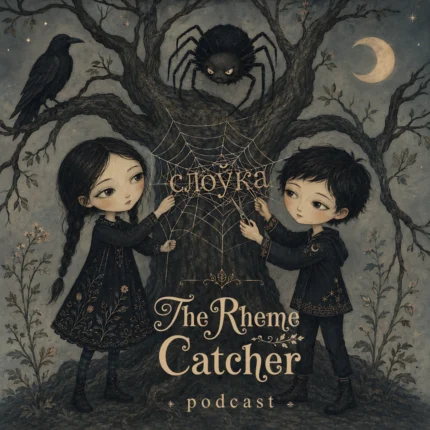
The title was inspired by the image of a dreamcatcher – a traditional protective object associated with the culture of the Indigenous Ojibwe people of North America.
A dreamcatcher usually consists of a circular frame with a web woven inside it. According to one tradition, good dreams find their way through the web to a person, while difficult and troubling dreams become entangled in it and disappear with the first rays of sunlight. The feathers often attached to a dreamcatcher are associated with air and the movement of dreams.
One legend tells of a Spider Woman who cared for the children of her people. When the people spread across different lands and she could no longer remain close to each of them, she began weaving protective webs to guard them while they slept.
This is how the dreamcatcher gradually became a rheme catcher. In linguistics, a rheme is the part of an utterance that conveys new information; here, the term is used more loosely for words that bring something new to the listener or that the podcast seeks to rediscover. Its web catches not dreams, but words that may have been lost, gone unnoticed, or fallen out of active use. It is important not only to find such words, but also to examine and understand them, preserve their meanings, and bring them back into everyday speech.
A language can easily be imagined as a large choir. Each voice sounds different, but together they create a shared melody. When some voices disappear or are forced into silence, the entire choir becomes poorer.
The same happens to words. Under the influence of russification, linguistic homogenisation, and other historical processes, part of the Belarusian vocabulary was displaced or marginalised. Some words disappeared from public use, while others survived only in regional speech or family memory. However, a half-forgotten word is not yet a lost word.
It may continue to live in an old dictionary, a literary work, or the speech of someone who uses it every day and does not even think of it as rare.
In this sense, words resemble amulets. We preserve them, but at the same time they preserve us – our memory, our distinct identity, and our connection with the people who spoke this language before us.
The more such words return to us, the better protected the language itself becomes from oblivion.
Another image behind the idea of the podcast is that of language as a vast forest.
This forest contains familiar roads that people follow every day. But it also has hidden paths, forgotten corners, rare plants, and unusual discoveries. Sometimes, to notice them, all we need to do is step away from the familiar road and look more closely at what is growing nearby. A single small word can become such a discovery.
Behind it, there is often an entire story: a trace of a particular person, time, place, and culture. Through words, we can see small universes and hear the voices of people who used them decades or even centuries ago.
The journey through this linguistic forest will follow several main paths.
The first path leads to Vitebsk and then across north-eastern Belarus. In the podcast, the Belarusian term vitseblianizmy (“Vitebsk regionalisms”) refers to words and expressions characteristic of Vitebsk speech. However, the boundaries of their use do not always coincide with the region’s administrative borders. The same words may be heard in Polotsk, Orsha, Mahiliou, and other towns and villages in north-eastern Belarus.
For example, malets means a boy or young man and is often perceived as a typically Vitebsk word. However, it is also used in Polotsk, Orsha, and Mahiliou. It is simply that Vitebsk, as the regional centre, appears to have claimed the right to represent the speech of the entire area.
Another, more local example is kalakalukha, the regional name for the bird cherry tree in Vitebsk and some other places.
There are hundreds of words like these. There is no need to lay them all out before listeners as one vast dictionary. It is much more interesting to catch them gradually – two or three at a time – examining them carefully and discovering where and how they lived.
Another important path concerns feminityvy, or feminine forms. The Belarusian term sometimes causes controversy or even frightens people, although it refers to a fairly simple linguistic phenomenon. Feminine forms are nouns used to refer to women by their profession, position, occupation, or social status. Belarusian examples include mastachka for an artist, senatarka for a senator, and autarka for an author.
In the Belarusian language, such forms are neither a passing fashion nor an entirely new phenomenon. They have a long history, although many of them were displaced or marginalised during particular historical periods. In Old Belarusian, for example, the word karalitsa was used for a queen. Later, karaleva became more common.
Today, feminine forms are gradually returning to active use. Some already sound completely natural, while others continue to generate debate. The podcast will therefore not only introduce such words, but also examine their history, structure, and context of use.
Some Belarusian words cannot be described as lost. They still exist in old dictionaries, in the works of Belarusian writers, or in the speech of older generations. Most of us rarely encounter them in contemporary public use.
It is particularly fascinating when a word that seemed to belong exclusively to a dictionary suddenly appears in everyday speech. You may find it in a nineteenth-century dictionary and assume that it disappeared long ago. Then you hear the same word spoken by an elderly woman in a Belarusian village in the twenty-first century. At that moment, it becomes clear that the word never vanished. It had simply survived elsewhere.
One such example is kilchyba. The podcast’s hosts plan to devote a separate discussion to its meaning and history.
Half-forgotten Belarusian words may turn out to be apt alternatives to loanwords that now seem ordinary and indispensable. By bringing such words back, we are not trying to artificially isolate Belarusian from other languages. We are simply reducing the distance between the language of the past and the language of the present.
A language not only preserves the past – it is constantly creating something new. Young people play with words, invent names for new phenomena, and create forms that did not exist before. Some of these new formations disappear almost immediately, while others take root and become fully established in the language. Linguists and sociolinguists observe this process, record new words, and compile specialised dictionaries.
The podcast will also explore newly coined words and expressions, or navatvory in Belarusian. This path may intersect with the others. A new feminine form may also be a neologism. A regional word may suddenly acquire a new meaning and return to widespread use. In the linguistic forest, paths do not always remain separate. They meet, cross, briefly merge into a single road, and then diverge again.
The Rheme Catcher is not meant to be a conversation between two people who supposedly know everything and merely pass their knowledge on to listeners. Even professional linguists cannot know every regional word, family expression, or local linguistic feature. Nor is it always possible to travel to a particular area and hear how people actually speak there. That is why the podcast is conceived as a two-way process.
Listeners can share their own words, memories, contexts, and linguistic nuances. They can explain how people speak in their town, village, or family, clarify meanings, and add details to the stories.
Collective knowledge can preserve far more than even the most talented individual researcher could.
Perhaps, somewhere at this very moment, a word is being spoken that cannot be found in contemporary textbooks or media. To the person saying it, the word is entirely ordinary. For everyone else, however, it may become a new path through the vast forest of the Belarusian language.
We only need to hear it in time – and catch it.
Besides leaving a comment, you can share your own words and expressions with us by email. Remember that you can delete the message from your Sent folder after sending it.
Our e-mail address is: help@belarus.fm