
Belarusian is full of words that may be perfectly familiar in one part of the country and virtually unknown in another. And they are not all relics of the past. Some emerged within living memory – with the arrival of the first mobile phones, for instance – only to disappear again a few years later. How many words like these do we even know today?
In the new episode of “The Rheme Catcher,” Zhenya and Uladzik (Uladzislau Harbacki – a sociolinguist and gender studies scholar) are back on one of their favorite trails: Vitebsk vocabulary. Among the words they’ve caught this time are nahrudnik, baukala, usukhi and tsiakunok. Where did they come from, and what do they mean? And at the end, we answer one more question: what do you call a woman who goes mushroom picking in Belarusian? Listen now!
And if you’re looking to read more by Uladzislau, you can find his books here.
The first mobile phones were huge – absolute bricks, as Uladzik puts it. People often wore them on a lanyard around their necks, with the phone hanging against the chest. In the Vitebsk region, phones like these came to be known as nahrudniki – “bibs,” because of the way they hung on the chest. You might hear someone say, “Take off your nahrudnik,” or “Your nahrudnik is already ringing.” Then phones changed. People started carrying them in their pockets, nahrudniki went out of fashion, and the word itself all but disappeared. It is one of those cases where a new name made its way into the language even though the word was only needed for a few years.
Another word, though, has stuck around. In the Vitebsk, Orsha and Liozna areas and nearby places, you can still hear baukats – “to call.” Baukni mne means “call me,” while Baukni doktartsy means “call the doctor” and ask her to come. There is also baukala, meaning a phone. These days it can mean not just a mobile phone, but sometimes a landline too. You can even bauknuts over Zoom. Baukala can also mean someone who talks on the phone too much or is constantly on it. So you get a whole word family: baukats, “to call”; baukala, a phone; and baukala, a person. Whether baukala will stick around in Belarusian remains to be seen. But people in the Vitebsk area still use it.
Not every Vitebsk regionalism gives you much of a clue to its meaning. Take usukhi. It sounds like it ought to have something to do with dryness, but Uladzislau, a “city boy,” had no idea what it meant at first either. Then, during a field trip, an older man who had gone swimming with them warned him: “Careful – there are usukhi there.”
Usukhi are submerged rocks or rocky mounds under the water. You can jump into a lake without seeing them and hurt yourself badly. And the word is specific to lakes – similar spots in a river have a different name.
The older man said places like that ought to have a sign saying “Usukhi.” Uladzislau jokes that visitors to the lake probably wouldn’t know what the sign meant. But maybe that would give the word a new lease of life.
Another find is tsiakun, or tsiakunok – a Vitebsk word for very fine sand that seems almost to flow like water. That is probably where the name comes from. Uladzislau compares it to the sand in an hourglass, or the kind that feels so good under your feet on a beach. Instead of the clunky description “very fine, soft sand,” there is a single word: tsiakunok. The name itself hints at what makes this sand distinctive: it comes from the same root as the Belarusian verb meaning “to flow.”
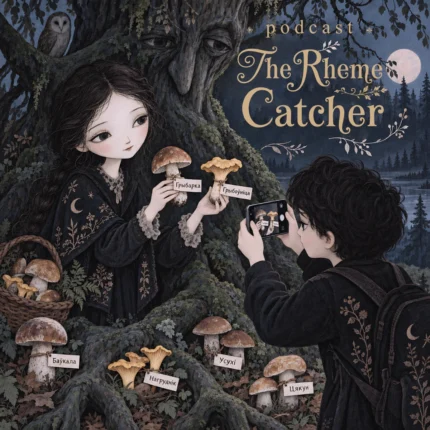
There was one question left over from the last episode: what is the Belarusian word for a woman who goes mushroom picking? Uladzislau says the word hrybounitsa – a woman who picks mushrooms – has been recorded in Vitebsk, Haradok, Orsha, Dubrouna, Liozna and Krapiuna, as well as in Hareliki and Dobramysli, two villages that no longer exist. His grandmother used the word for herself too: “I’m a good hrybounitsa.” The corresponding masculine form is hrybounik, not hrybnik.
Another, rarer form was hrybarka, derived from hrybar. But hrybounitsa does not appear in the “Regional dictionary of the Vitebsk region: in two parts” (Рэгіянальны слоўнік Віцебшчыны: у 2 частках), compiled at Masherov Vitebsk State University. That does not mean the word was never used, though. Uladzislau’s research over the past 20 years shows that people did use it – the dictionary may simply not have covered every village and local dialect.
The linguist himself does not suggest that hrybounitsa is the only Belarusian word for a woman who picks mushrooms. He keeps using it because that was the word used in his region – and the word his grandmother used.
And tell us yours: what did people in your part of Belarus call a woman who went mushroom picking?
Send us your words in the comments or by email at Belarus FM. Remember that you can delete the message from your Sent folder after sending it.
Our e-mail address is: help@belarus.fm