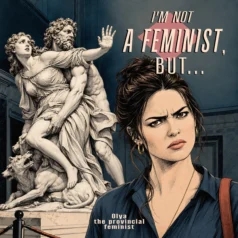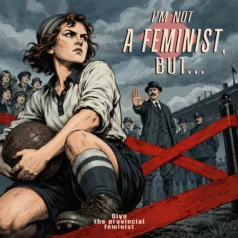

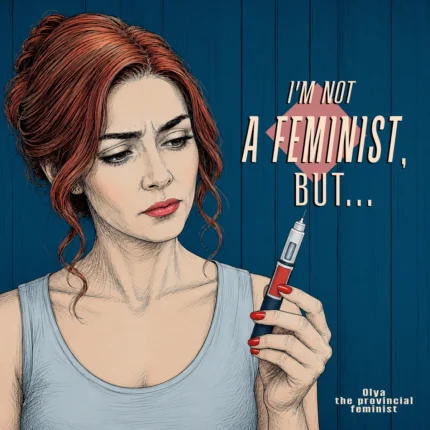
This episode looks at the connections between feminism and women’s weight, weight loss, Ozempic use, the pressure women face over their appearance, and the different standards men and women are held to when it comes to looks.
A woman is expected to be beautiful, to look a certain way, and weight is one of the main criteria here – whether we pass this patriarchal screening as an approved, f*ckable commodity, whether we fit within the accepted, seemingly timeless standards. I devoted episode 5 of the first season, “Why do women actually wear makeup?”, to the objectification of women. Weight is one of the key measures of whether a woman conforms to patriarchal standards, so when a woman deliberately loses weight, it is often driven by this very need: to fit existing standards and meet the expected parameters. That makes life easier in the world as it is, because if you play by the rules, your chances of survival are higher. I also want to point out that it is not only women with what we might call excess weight who suffer from falling outside the “right” weight category. Thin women are subjected to pressure as well.
Who hasn’t heard the saying, “A man’s not a dog – he doesn’t go for bones”? Notice that a woman is judged solely in terms of what men want. A woman is expected to conform to whatever a man wants. In other words, in a patriarchal world, the man is the reference point in the coordinate system – I will never get tired of pointing this out. Everything is built around the man: his comfort, his desires.
While I’m on the subject, I want to say this to women once again: don’t fall for benevolent sexism. There is nothing in patriarchy that is good for women – it’s a trap. Under patriarchy, a woman is always an object. I talked at length about benevolent sexism, all this chivalry – helping a woman with her coat, pulling out her chair – and why it is bad for women in episode 4 of the first season, “Women are bullied for refusing: would-be rapists and other dangerous traditions”.
But there can be other reasons to lose weight. For example, excess weight can harm your health and reduce your quality of life. From this perspective, losing weight without regard to patriarchal beauty standards or expectations of how a woman should look can be seen as a form of feminist self-care.
Ozempic is a tool that can make it easier to lose excess weight, while psychotherapy during and after weight loss can help build a healthy relationship with food, making it possible to keep the weight off and enjoy life at the weight that feels right for her.
It all seems perfectly logical, and yet women who use medication to lose weight are often bullied for daring to take what is supposedly the easy way out. I see countless comments saying that this kind of weight loss isn’t “real.” And I think these beliefs are rooted in female gender socialization, which teaches women to endure and treats suffering as something virtuous. How can you not think of sayings like “If you’re not f*cking exhausted, you’re not a mother”? “Beauty requires sacrifice”? Or “You’ll put up with it, and then you’ll learn to love it”? Women are raised from the outset to expect a life of suffering and endurance. So weight loss without pain and struggle provokes this kind of outrage.
There’s something else, too. I noticed that as soon as my body began to take on more and more conventionally acceptable – traditionally approved – contours, I wanted to take even more photos of myself, emphasizing my figure and choosing angles and poses. I started paying attention to style advice and, of course, found my own special circle of hell in all those recommendations. In trying to conform to an imposed ideal, we are constantly hiding some things and emphasizing others. Clothes are supposed to make you look slimmer and elongate your silhouette; plus-size girls absolutely must not wear this, stylists say, but this is fine – it will hide your “problem” a little. And there I was, a feminist who understands all of this perfectly well, realizing just how deeply it is ingrained in me – how much I, too, want things to make me look slimmer and taller, and oh no, anything but making my legs look shorter! I even caught myself feeling pleased that I got lucky with my body type – it’s practically conventional!
I believe female gender socialization instills lookism in women – the idea that appearance matters enormously. There’s a saying: “People judge you first by your clothes, and later by your mind.” At first glance, it seems gender-neutral. But we all know there’s a difference. The expectations for men’s appearance are simple: their clothes should preferably be clean, and ideally, they should have showered. The saying that a man only needs to be slightly better-looking than a monkey shows just how low the bar is for men when it comes to both their looks and their clothes. Women are held to a completely different standard.
I’ve also noticed that men are now facing more expectations when it comes to their appearance and grooming. I think the beauty industry has simply adapted so it doesn’t miss out on profits. But there has been no systemic change. A man is still king and god, and beautiful simply by virtue of existing. And I still haven’t seen anything about what age or weight is unacceptable for men, whether fuller lips suit them, how they should hide their crooked legs, or how they urgently need to lose weight for summer; how they should look and behave in general so that at least one woman will agree to marry them, and so on. So yes, there is some pressure from the beauty industry because it wants to make money from men too, but that is nothing like what I would call the institutional pressure placed on women.
This episode does not constitute medical advice, a medical consultation, or an advertisement for any weight-loss medication. Any decisions involving medication should be made only in consultation with a doctor and with your individual health circumstances taken into account.
If you’d like to get in touch with us, you can email us. Don’t forget to delete your message from your Sent folder afterwards.
Our address: help@belarus.fm