

Feminine forms are sometimes seen as something new, fashionable, or even artificial. But they are nothing new in Belarusian. Nastaunitsa (teacher), dyraktarka (director), shliakhtsianka (noblewoman), sialianka (peasant woman) – all are feminine nouns referring to women by profession, position, occupation, or social status.
In Belarusian, we use feminine forms every day without even thinking about it. Debates usually arise around feminine forms that have been less common in the public sphere. In recent years, feminine forms have been marginalized and are only now returning to wider use.
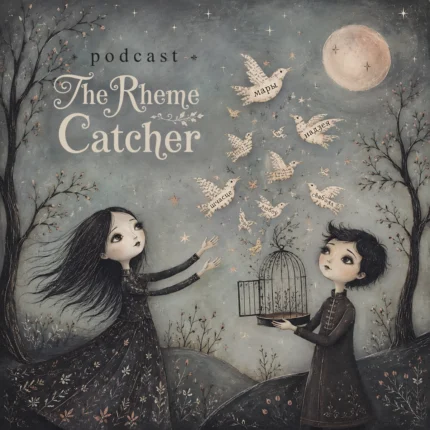
In the third episode of the podcast “The Rheme Catcher,” Zhenya and Uladzik (Uladzislau Harbacki – a sociolinguist and gender studies scholar) set off down a new trail into their linguistic forest – the trail of feminine forms.
What purpose do feminine forms serve in a language? One of their functions is very simple – they make it clear who is being referred to.
Uladzislau recalls an online story from a Belarusian news outlet saying that the Estonian president had married Latvia’s cybersecurity chief. The official was a woman, but the story used the masculine Belarusian form kiraunik (chief) to refer to her. Since the Estonian president was a man, some readers took this to mean that he had married another man. The photos and context made it clear that the official was a woman, but some readers had already got the wrong idea. If the feminine form kiraunitsa had been used instead, there would have been no ambiguity.
So the discussion around feminine forms is not just about linguistic trends or identity. Sometimes it is simply a matter of precision.
But what, for example, do you call a woman in prison? Belarusian has the familiar word viazien (prisoner). But what would the feminine form be?
This is where things get interesting. It turns out that Belarusian had not one but several options. But what became of them? Can you remember even one such word?
In dialects and older texts, you can find the words viazneuka and viazniouka. Linguist Ales Kaurus recorded this form, including in reference to women who had lived through political imprisonment and the Gulag.
In the Vitebsk region, there was also the form viazniarka. Uladzislau’s grandmother, for example, used this form. In other dialects, viaznichka was also used.
There was even an attempt to establish viáznitsa in dictionaries as the feminine form of viazien. Belarusian already has the word viaznítsa, with the stress on the second syllable, meaning “prison.” The proposed feminine form had the stress on the first syllable – viáznitsa. But it never really caught on in everyday speech.
So Belarusian already had several ways to refer to a woman in prison. But these words either remained rare and dialectal or were known only to a relatively small number of people.
And so in 2022, the team behind a project supporting women political prisoners ran into the same problem. What form should they use when viazien already existed, but a natural, widely understood feminine equivalent was hard to find? That is how the new word palitviazynka came about.
The word sparked discussion and debate among linguists. Its structure is unusual for traditional Belarusian word formation, and even its stress pattern has not yet fully settled.
But the story of how it came about is revealing. The younger generation could not find the word it needed in current usage, so it created a new one. While older dictionaries and dialects preserved the little-used viazneuka, viazniouka, viazniarka, viaznichka, and even viáznitsa, which was recorded in dictionaries but never caught on, modern Belarusian gave rise to palitviazynka.
Will viazneuka or viazniouka return to widespread use? Will the regional viazniarka or viaznichka live on? Or perhaps the new palitviazynka will eventually become the most familiar form? That is for the language itself to decide.
Words can live for centuries, disappear for generations, return from old books, or be born right before our eyes. And sometimes several forms coexist for a long time, until speakers settle on the word that fits best and works best in practice.
So when it seems that Belarusian has no word for something, we do not always need to coin a new one right away. Sometimes it is worth looking back through the history of the language first. The word we need may have existed before and simply be waiting for us to start using it again.
And if not, the language can always create something new. That, too, is a natural process. Time will decide what happens next. Time, and all of us – the people who use this language.
Send us your words in the comments or by email at Belarus FM. Remember that you can delete the message from your Sent folder after sending it.
Our e-mail address is: help@belarus.fm