
There are hundreds of words and expressions characteristic of the Vitebsk region. Some of them were included in Mikalai Kaspiarovich’s well-known regional dictionary, published about a century ago. Others were collected by philologists at Vitebsk State University, named after Piotr Masherov, and included in two-volume dialect reference works. But even these publications do not capture the full linguistic richness of the region.
Many words were never fully documented – they were never precisely defined or given their own entries in dictionaries. Researchers recorded some of them, but noted only one of their meanings. Others still exist only in spoken language.
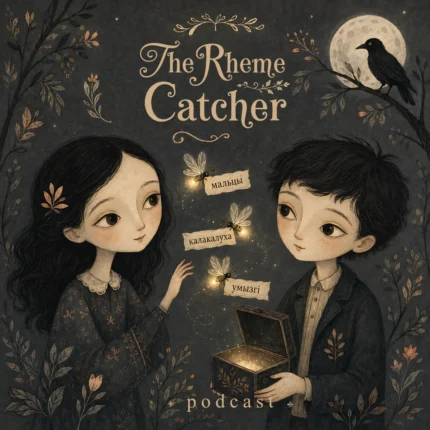
That means the rheme catchers have plenty of work to do. So in the second episode of the podcast The Rheme Catcher, Zhenya and Uladzik (Uladzislau Harbacki – a sociolinguist and gender researcher) set off down the first trail into their linguistic forest in search of Vitebskisms.
What are Vitebskisms? They are words and expressions characteristic of Vitebsk and northeastern Belarus. They can also be heard around Orsha, Polotsk and Mogilev, and even in the Smolensk region, but in many people’s minds they are associated specifically with Vitebsk.
You have to listen to how people speak, pay attention to local expressions, compare them with old records, and trace how words have changed over time. Because a word may already seem to have been “caught” and entered in a dictionary, yet still resist precise definition. It spills beyond the bounds of its dictionary entry, takes on new meanings, and lives on.
That is exactly what happened to the word malets. It is one of the best-known Vitebskisms and something of a calling card for the region.
For people in Vitebsk, maltsy sounds more natural as a form of address than khloptsy. It can be used to address friends, acquaintances, or a group of men. Outside northeastern Belarus, however, the word may not always be understood as intended.
Uladzislau recalls that after moving from Vitebsk to Minsk, he referred to his new friends as maltsy. They were surprised and even a little offended: “What’s with this maltsy-paltsy?” – a teasing rhyme on maltsy, rather like the English fancy-schmancy. In Minsk, people would normally say khloptsy (guys) in that situation. Maltsy sounded odd to them because in Belarusian the word has come to mean “teenagers” – in other words, it refers specifically to age.
Little linguistic misunderstandings like this show just how varied Belarusian can be even within our own country. After all, in everyday Vitebsk speech, malets has a much broader meaning.
During sociolinguistic fieldwork, Uladzislau heard villagers say, “There are maltsy standing by the well.” But the people standing by the well were not teenagers – they were grown men.
Among older speakers, malets can simply mean a man, regardless of age. So it does not necessarily mean a young man. It can refer to men of different ages in everyday conversation.
The word has also developed narrower meanings within particular social groups. In local gay argot, malets can mean an attractive gay man. Argot, incidentally, is vocabulary specific to a particular social community. It allows members of that community to name their own experiences and understand one another, even when those meanings are not obvious to outsiders. You could describe it as a kind of coded language in which words take on meanings understood only within certain groups.
It can also be used to refer to one’s partner. Interestingly, malets is used in this sense even by russian-speaking Belarusians in Vitebsk. They may not speak Belarusian, yet still call their partner malets.
So a single regional word can carry several meanings at once.
Maltsy can mean guys, teenagers, or men in general. In certain contexts, it can also refer to partners or attractive gay men.
Not all of these meanings have yet been recorded in dictionaries. So malets remains a living word, continuing to evolve and outgrow traditional definitions.
The next word is much less widely known: umyzghi.
It was used in Vitebsk, Liozna, Orsha, Dubrovna, and other parts of northeastern Belarus. The word appears in nineteenth-century ethnographic records, old folk songs, and regional dictionaries.
Uladzislau learned the word from his grandmother. When she reminisced about her youth, she would tell him how she used to go on umyzghi with a young man.
Old records also contain phrases such as “The girls went on umyzghi” and “The maltsy went on umyzghi.” But what does it mean?
Umyzghi means wooing, or a romantic meeting with someone you like. In modern language, you might call it a “date,” a “romantic encounter,” or a “rendezvous.” But umyzghi carries a particular emotional tone.
It is not simply a meeting between two people. Usually, it refers to the early, tentative stage of a relationship. The two are only beginning to get to know each other, wooing one another, feeling shy, taking walks together, and not yet in a hurry to put a label on whatever is happening between them. In other words, umyzghi are romantic but platonic meetings.
You can not only go on umyzghi yourself, but also ask someone you like to go on umyzghi with you.
The word was known beyond the Vitebsk region as well. It also found its way into dialect dictionaries from the Smolensk region.
This is not surprising, since Belarusian dialects had a strong influence on the speech of neighboring areas, especially in border regions. As a result, Smolensk dialect dictionaries contain many words of Belarusian origin, with northeastern Belarusianisms and Vitebskisms particularly prominent among them.
Today, umyzghi has all but disappeared from the speech of younger generations. It can still be heard from older people in the Vitebsk and Orsha regions, but it has become rare in urban speech. That alone makes it worth reviving – if only so we do not have to call every romantic meeting a “date,” a “rendezvous,” or a “meet-up.”
Our grandparents used to go on umyzghi. Perhaps Belarusians today can do the same.
The third word has almost disappeared. It is another well-known Vitebskism that is now at risk of dying out. It is recorded in dialect dictionaries and in Kaspiarovich’s regional dictionary, but few people use it today. Even in Vitebsk itself, many people are surprised when they hear it.
The word is kalakalukha.
What is kalakalukha? It is a tree with white flowers that usually blooms in late April or early May. It is easy to recognize by its strong, sweet scent, which is especially noticeable in the evening. Essentially, kalakalukha is an older synonym for charomkha (bird cherry).
In Vitebsk, people might say, “Tsvitse kalakalukha” (“The kalakalukha is blooming”). Incidentally, tsvitse (“is blooming”) is another form characteristic of local speech and coexists with the standard Belarusian kvitneye.
Kalakalukha begins to bloom at almost the same time as lilac. But while lilac is well known and loved, kalakalukha often remains in its shadow. It is something of a linguistic and botanical Cinderella beside the lilac.
Its white flowers are rather modest, and not everyone likes its strong scent. In Belarusian tradition, branches of kalakalukha were generally not brought into rooms where people lived or relaxed. The tree was left outside, its fragrance carrying through the air from a distance.
In folk tradition, kalakalukha was often associated with beauty and young women.
Some researchers believe the name itself is very old. It may preserve traces of pre-Christian, pagan beliefs and of the traditional folk way of naming the world around us.
There is another mystery associated with kalakalukha. Old Belarusian sources mention pies being baked with its flowers. The name of the dish, or references to the custom itself, have survived in memories and written records, but detailed recipes are still hard to find. Perhaps somewhere they are still waiting to be discovered by researchers.
These three Vitebskisms show three different ways words can live.
Maltsy remains firmly rooted in everyday speech and continues to acquire new meanings, but dictionaries have not kept pace with its evolution. Umyzghi is still remembered by older people, but younger generations have almost stopped using it. Kalakalukha has been documented by researchers, yet is gradually disappearing even in the region where it was once a common name for a familiar tree.
But a word does not necessarily disappear forever. Sometimes all it takes is to say it again, explain it to someone else, and use it in a new sentence. It can find its way back into the language. That is exactly what the rheme catchers do.
They seek out words that have yet to make it into dictionaries, clarify the meanings of those already recorded, and bring forgotten words back into contemporary language. But you can share your own words too – help clarify what they mean and add to their stories.
Send us your words in the comments or by email at Belarus FM. Remember that you can delete the message from your Sent folder after sending it.
Our e-mail address is: help@belarus.fm