
Why have the same stories been treated as romantic for centuries when they are really about abduction, coercion, and even violence? In episode 3 of season 2 of the podcast “I’m not a feminist, but…”, I look at films and other works through a feminist lens. What lies behind the so-called “beauty of form,” and what place are women given in art in a patriarchal world? Why do people romanticize violence, sometimes without even realizing it? And why is there still no disclaimer for any of this, while entire series of books with LGBTQ+ themes are so readily censored?
A good place to start is the myth of the abduction of Europa. According to the ancient Greek story, Zeus transformed himself into a beautiful, gentle bull, charmed the young woman, and then carried her off to Crete against her will. Over time, this story of abduction and violence became one of the most important motifs in European culture. Artists across the centuries depicted it in painting and sculpture, and it was also used in architecture and symbolism. Yet Europa herself often remains little more than part of a beautiful composition, while the violence she endured dissolves into poetic descriptions. Just listen to how poetically russian-language Wikipedia describes this rape: “On the island of Crete, Zeus assumed the form of a handsome young man and took possession of Europa.”
Does it matter that this is “just” an ancient myth? Stories affect us regardless of whether the events they describe actually happened. From childhood, fairy tales, legends, books, and films teach us to tell right from wrong, understand the consequences of people’s actions, and choose who we look up to and what patterns of behavior we follow. If a powerful man abducts a woman, coerces her, and goes unpunished, while the story itself is preserved as beautiful and romantic, it passes down a very specific idea of what is acceptable.
The myth of Europa is far from the only story like this. Medusa, whom popular culture has turned into a monster with snakes for hair, was, in one version of the myth, a young woman who suffered violence at the hands of Poseidon. She tried to seek refuge in Athena’s temple, but the punishment fell not on her attacker, but on Medusa herself. The story bears an unsettling resemblance to modern discussions about why a woman was in a particular place, what she was wearing, and whether she resisted convincingly enough. Once again, responsibility is shifted from the man who committed the violence to the woman who suffered it.
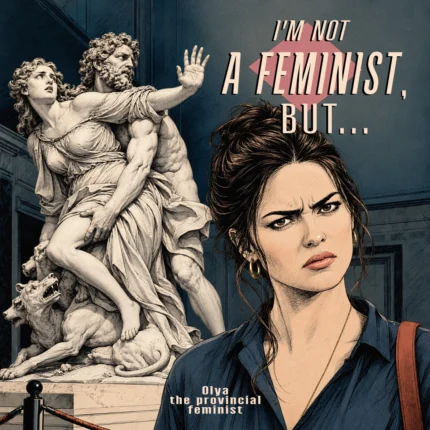
Another example is Gian Lorenzo Bernini’s famous sculpture “The Rape of Proserpina.” Viewers and art critics marvel at how the sculptor managed to capture in marble the softness of skin, the movement of the fingers, the young woman’s tears, and the tension in their bodies. That admiration for his skill is understandable: the ability to turn stone into something almost alive is genuinely astonishing. But why does the discussion so often stop at technique? Why does a woman’s suffering become merely an opportunity to admire the expressiveness of the composition, rather than a subject in its own right?
A feminist lens does not require us to stop seeing the beauty in a work of art. But we can pay attention to its content as well as its form. We can recognize the sculptor’s genius while also understanding that what we are looking at is not a love scene, but a moment of abduction and coercion. One does not negate the other. On the contrary, knowing the context allows us to see art more honestly.
Violence is normalized not only through images, but also through the language used to describe them. Phrases like “took possession of the young woman,” “took her as his wife,” or “proposed the old-fashioned way – by kidnapping her” turn a crime into a romantic adventure or an amusing custom from the past. But practices like these have not disappeared: women are still abducted and forced into marriage today, and the belief that a woman’s “no” can mean “yes” continues to shape everyday relationships.
Then there is the story of Rogneda, who refused to marry Prince Vladimir. Her refusal was followed by violence, the murder of her family, and a forced marriage. Yet in popular culture, Vladimir remains above all a great ruler, the man who brought Christianity to Rus’, and the hero of monumental paintings, statues, cartoons, and patriotic narratives. To see another side of this image, people have to seek out the historical record for themselves. At the surface level, culture preserves the heroic version, with the woman’s experience almost entirely left out.
This is where memes can be surprisingly useful. In just a few lines, they can dismantle a familiar heroic image and bring back into the story the facts that grand cultural narratives prefer to overlook. Where a museum caption tells us about the greatness of a ruler, a short meme can remind us of the price other people paid for that greatness. In this sense, humor becomes an accessible educational tool. And there is a great meme about Prince Vladimir: raped Rogneda, killed her parents and brothers, made her his wife, had 300 mistresses, killed his own brothers… became a saint.
But what should we do with works created in a different era that reflect the values of their time? Ban films, remove books, tear down monuments, or rewrite myths? I suggest using disclaimers – brief notes that put a work back into its historical and ethical context.
A museum label like this can state plainly that what we are looking at is a scene of abduction or violence. An introduction before a film can draw attention to how slavery is romanticized, as well as to racism or outdated ideas about women. A note in a children’s book can explain that the heroine’s behavior is not necessarily something to emulate. Viewers and readers are still free to make up their own minds about the work, but they do so with more complete information.
A telling example is “Gone with the Wind,” which HBO temporarily removed and then brought back with additional material about its historical context and portrayal of slavery. The decision sparked debate about censorship and whether society was being deprived of its cultural heritage. But a disclaimer does not ban or erase anything. It does not change the content of the film – it simply helps us see what the traditional narrative left out of frame.
A feminist reading of “Gone with the Wind” is not limited to the question of slavery. For several generations, Scarlett O’Hara has been seen as a symbol of female strength, yet the book also reproduces numerous expectations of what a “real lady” should be like: how she “should” look, how much she is “allowed” to eat, what her weight “should” be, and whether it is acceptable to show an appetite in front of a man. For a girl who encounters similar expectations at home, in advertising, at school, and on social media, it can be hard to see them in an old book and conclude, on her own, that they belong in the past. Cultural stereotypes reinforce one another and begin to look like the natural order of things.
This is why explanations are especially important in children’s books and cartoons. Neither the Little Mermaid, who gives up her own voice for love, nor a heroine whose whole purpose in life is to wait for a prince has to disappear from our culture. But a child can be told that this is not the only possible way to live. A girl has value in her own right, regardless of whether she meets other people’s expectations, gets married, or is willing to sacrifice herself for someone else’s attention.
These kinds of notes can be useful for adults as well. Many ideas are absorbed so early that they stop feeling like imposed restrictions. Sometimes a single well-phrased sentence is enough to make someone wonder for the first time why they think certain behavior is expected of women, or why they fail to recognize violence when it happens within a marriage or an outwardly happy family.
A disclaimer understood this way is not censorship but a way of placing content in a contemporary context. Censorship bans, removes, and erases ideas it finds inconvenient. I think everyone has seen the books that have started appearing with entire pages blacked out, and that is something else entirely, because what is being erased is precisely what should be shown and talked about instead. Censorship, on the other hand, is being used to drag people back to a time when, for example, someone could be killed for having the “wrong” sexual orientation. An explanation, by contrast, adds information and opens up more room for reflection. It does not stop us from admiring Rembrandt’s golden light or Bernini’s skill, but it does keep us from forgetting whose suffering lies at the heart of a beautiful work of art.
So why, for example, is the context of the tragedy usually made absolutely clear in exhibitions on wars, political repression, or the Holocaust, while scenes of violence against women are often displayed as aesthetic objects with no explanation at all? If a museum had a sculpture depicting the sexual assault of a man, would art critics speak with the same admiration about the “yielding flesh” and sensuality of the composition without ever naming what was happening?
A feminist lens does not provide universal answers, but it helps us ask questions. What exactly are we looking at? Whose perspective does the work represent, and whose voice is missing? Why are a man’s actions described as passion or heroism, while the woman is expected to feel shame and bear the consequences? What old narratives continue to shape modern ideas about consent and “proper” female behavior without us even noticing?
In the episode, these questions are explored through many more examples from mythology, history, literature, film, and museum culture. Some of them can make us see works and historical figures we have known since childhood in a completely different light. So I invite you to listen to the episode, take a closer look at familiar stories, and decide for yourself whether works of art need explanatory labels and why it is so important to know exactly what we are looking at.
The #daughter_of_museums series and more:
https://www.instagram.com/wild_fem_/
If you’d like to get in touch with us, you can email us. Don’t forget to delete your message from your Sent folder afterwards.
Our address: help@belarus.fm