
Why does men’s football get funding and airtime while women’s football is called niche? Don’t confuse cause and effect: the story of a 50-year ban, examples of sexism in sport and beyond, the myth of low demand, and what can be done about it.
So, would you agree that the hype and demand around the World Cup are driven by smart marketing? That the tournament is heavily promoted, all kinds of merchandise is produced, public screenings of matches are held not only in sports bars but in all sorts of public spaces, even stadiums, and footballers’ faces appear on packets of crisps?
Besides this kind of massive promotion, which sweeps people along – including some who might not otherwise have got involved without all that surrounding hype – there’s another argument: businesses put money into whatever will turn a profit, and it makes no difference whether it’s men’s or women’s sport!
This is where people confuse cause and effect, and it’s a very basic, glaring mistake.
The reason is that in a patriarchal world, everything important and worthy of attention is male. Because the subjects – the people who do things and make decisions – are assumed by default to be men. So of course money will be invested in what is associated with men as people, rather than with those who serve them.
Recently, a flower shop in Minsk posted what it apparently thought was a creative ad. The photo showed a man holding different bouquets, with the caption: “Correct us if we got any of the flower names wrong.” The message was pretty clear: the man is choosing flowers to give to a woman, while the altered flower names hint at what he expects in return. The names included “пихоны” (pikhony, approximately “peonies-n-penis”), “подсосолнухи” (podsosolnukhi, approximately “suckflowers”), “шпилилии” (shpililii, approximately “lilies-n-willies”), and “глоталусы” (glotalusy, approximately “gladiolus-n-throat-us”) – crude sexual distortions of ordinary russian flower names. It’s a very obvious innuendo, and it neatly reflects the patriarchal division of roles: the man is a person, a subject, choosing a gift for the woman-object, who will then “put out” in return. If we start from the assumption that businesses invest in whatever makes them money, regardless of whether it has to do with men or women, this simple example already disproves it. This business invested money in something that outraged its target audience; some people will no longer order flowers from this shop. In other words, the risk of losing profit was never factored in. Why? The reason is that in patriarchy, men are the reference point. A man is a person, while a woman exists to please him, so of course he finds it funny: which flowers should he pick so that any woman will “put out” for him – and why not make it a bit more inventive? Look how creatively he’s reworked the flower names around what he wants. It never even occurred to the business owner that this joke might be offensive to women, because this is treated as reality, as the way the game works: a man chooses luxurious bouquets, takes a woman to a restaurant, courts her beautifully, and she “puts out” in return. Well, that’s the usual arrangement, just dressed up in pretty words and romantic gestures – so why wouldn’t it be funny to joke about it? But women don’t find it funny at all – even those who love romantic courtship and get upset with feminists for puncturing these fairy tales and calling them by the ugly, offensive name “benevolent sexism.” Yet as soon as the flower shop crudely exposed what this arrangement is really about, women found it deeply unpleasant. And women make up a huge part of a flower shop’s target audience! A joke like this poses a major risk to the business: at the very least, reputational damage, and at worst, a serious drop in profits.
It’s important to understand that the man who came up with this flower ad isn’t some exceptionally bad man. No – he’s an ordinary patriarchal man, because in his world it is normal for a woman to be an object, for him to have to do something so that she will “put out” for him. That’s why he finds the whole peonies-n-penis joke funny. It would be a mistake to think that this one man is bad and that this is an isolated case. This is how the system works. Male gender socialization gives men this particular wiring; this is the baseline, the default setting. Of course, some men who are “not like that” do exist – but they exist in spite of the system.
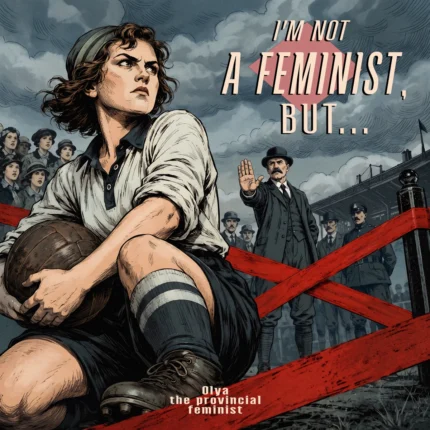
One of the first women’s football clubs, the British Ladies’ Football Club, was formed in England in 1895, nearly four decades after the first men’s football club was formed. Men’s clubs had grown out of factories, where men worked, while women stayed at home, running the household and looking after the children. The club was put together by an enthusiast, Nettie Honeyball, who placed an ad in a newspaper. Ten thousand people turned up to gawk at their first match, and the women were ridiculed. But they kept going – and, of course, the whole thing was funded by a woman as well. By the early 20th century, women’s football in England was drawing crowds comparable to those at men’s matches. So you’d think: what would a business do if it simply invested in whatever people were interested in and whatever could make it money? Logically, it would start investing in and promoting women’s football too, right? That would make sense if business investment – or the lack of it – were the cause. But it wasn’t. That is not what caused women’s football to become supposedly “niche.” The cause was the patriarchal view of women and their place in the world. And that is why business did not invest in it.
During the First World War, Dick, Kerr Ladies toured the country, playing charity matches to packed stadiums. Over the course of several years, they raised the equivalent of around £14 million in today’s money and donated it to hospitals, veterans, and orphaned children. In 1920, Dick, Kerr Ladies played St Helens in Liverpool, and 53,000 people came to watch the match! For comparison, average attendance at men’s football matches at the time was 24,000, while Chelsea, who held the league attendance record, drew crowds of around 42,000. So what was that about women’s football not being profitable, nobody turning up, and investment never paying off? Clearly, that wasn’t the issue.
The fragile male ego couldn’t handle such an outrage, and on 5 December 1921, the Football Association simply banned women’s football from FA-affiliated grounds: “Complaints have been made as to football being played by women, Council feel impelled to express their strong opinion that the game of football is quite unsuitable for females and should not be encouraged.”
The Women’s World Cup will be held in Brazil in 2027, and I, for one, am absolutely going to watch it – and I encourage everyone else to do the same. I also suggest paying attention to the scale of the promotion it gets, and whether we’ll see female footballers’ faces on packets of crisps.
If you’d like to get in touch with us, you can email us. Don’t forget to delete your message from your Sent folder afterwards.
Our address: help@belarus.fm